Revitalizing the Classics through AI: Towards a Practice of Virtuous Slop
Written on
TLDR: GenAI unleashes tidal waves of slop; as the flood grows, should we at least pragmatically 'slop' towards beneficial ends? Interestingly, recent tech is capable enough to remap timeless classics into digestable slices. The hope is to make wisdom more accessible and viral -- without losing our souls in the process. I demonstrate some possibilities through translating Shakespearean sonnets into rap, philosophical arguments into a Street Fighter-esque game, Plato's dialogues into iMessage exchanges, and a pipeline for 'translating' public domain books into more-easily-read styles. The aim is to slop with integrity: (1) to generate content with purpose, (2) to do so with as much creativity and taste as possible, (3) to financally offset usage of morally questionable AI tools, and (4) to seek and support interventions that undermine the business model of slop as a whole.
Teaser
|
|
|
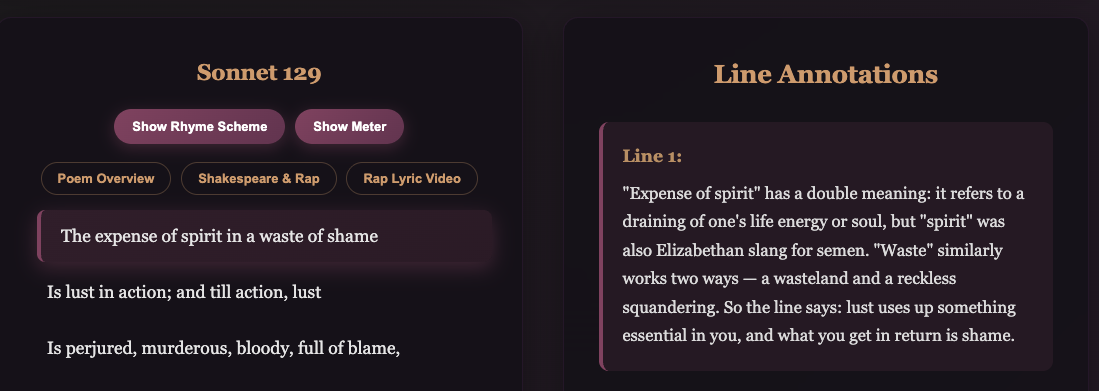
- Using a combination of Suno, Neural Frames, CapCut, and Claude, I created the music video above and this line-by-line interactive explorer of Sonnet 129 (an angry tirade by Shakespeare about lust).
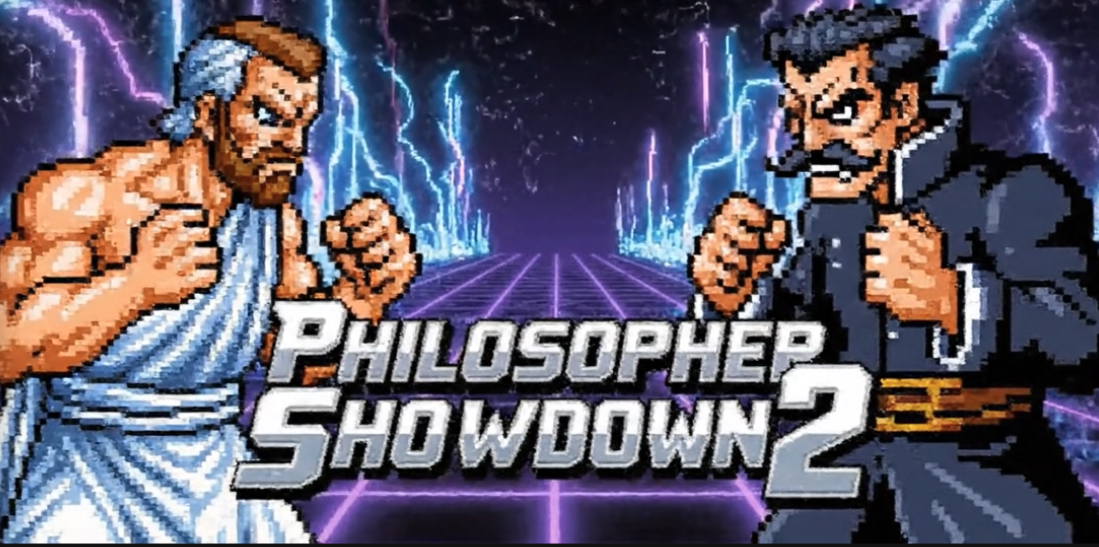
- Using Suno, Codex, Eleven Labs, Veo 3, and Gemini 3, I created a Philosophy meets Street-Fighter clone, in hopes of finding a game mechanic that makes learning about philosophical arguments more fun.
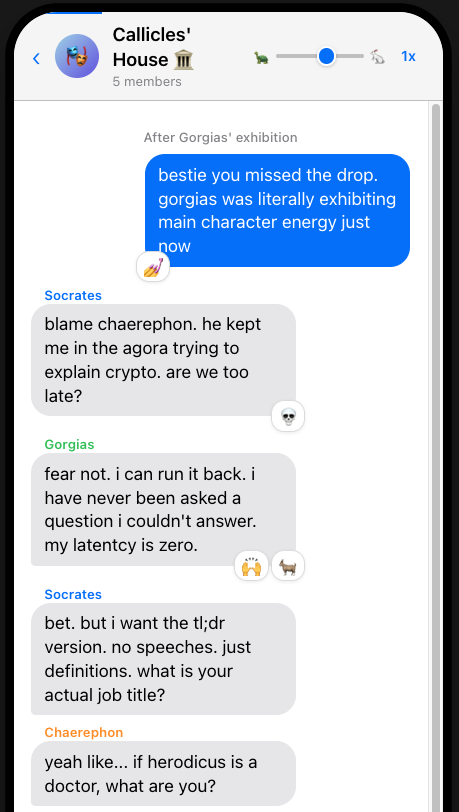
- Using Claude and Gemini, I created a Plato's Dialogue as Group-Chat interface, to make introducing some of Plato's philosophy more engaging.
Introduction
AI slop sucks. It's content about nothing, aimed at our basest instincts, motivated by vicious ends: money and influence for their own sake. I generally regret the time I spend scrolling an infinite feed, but feel a special flavor of self-loathing when I spend a moment hooked by some AI-slop thirst-trap video.
AI tools themselves, like Suno (for creating music), or DALL-E (for images), are at best ethically questionable. They're built from the creative works of human artists, yet do not compensate them. And perversely, they undermine the very livelihoods of the artists that they cannibalize.
Yet, these same AI tools offer a single creator incredible leverage, can be incredibly fun to work with, and democratize creative expression. I've had a great time with Suno in particular. It enables me to remix and reimagine songs I wrote in college, and has enough glitchy edges to create delightful weirdness at times.
So, one question I'm interested in is: Can there be a virtuous practice of slop? Is there a principled way to use these tools to create content (at scale) that is a net benefit to society?
Wisdom Arbitrage
There are likely other approaches, but what I pursue here is that there is timeless beauty and wisdom held in many public domain works (e.g. Shakespeare, Plato, Chekov), that is difficult to digest for many people, but with effort could be made more modern and relevant. And AI models have become capable enough to perform that effort, especially if one is creative.
For example, the dialogues of Plato are conversational (and funny -- as Socrates is a great troll), and can be presented as a groupchat exchange. In some sense, LLMs open up the possibility of wisdom-arbitrage: Take these classic works, run them through various AI pipelines, and the resulting content can retain most of that wisdom while gaining competitiveness in the attention economy. Most of this post describes a few efforts to do just that.
Cursed Tools
But even if one has beneficial aims, you have to also wrangle with the ethics of the tools themselves; while a gray-area legally, AI companies train liberally on copyrighted data, and more broadly have "created value" by mining the commons (e.g. the internet). Our technology moves faster than our laws, and while of course it is legal to use tools like Suno or DALL-E, it is ethically suspect.
So, in the process of this project I decided to attempt to "offset" my usage, just as one might offset greenhouse gas emissions. There are likely more principled approaches, but I donated to MusiCares and The Authors Guild. Perhaps a non-profit waiting to be started is something in the LLM-offsetting space -- as I'm not sure of what the most effective ways to spend money are to (1) support working artists and authors, and (2) to advocate for sane policy change.
Game Change
Finally, there are the ethics of working within the attention economy (e.g. attempting to create viral content by sacrificing depth and nuance) vs. trying to change the system (e.g. trying to undermine the attention economy itself). An author I admire (Hanzi Freinacht), talks about how to go beyond this binary.
One failure mode is game acceptance: Assuming that the system is unchangable and just juicing the hell out of it. This is the Mr. Beast approach -- accumulating money and influence through horrendously vapid yet masterful attention-economy spectacle; then donating some of the proceeds to charity. The other failure mode is game denial: Attempting moral purity and idealism by opting out of the game completely. This is the delete-all-social-media approach -- sure, some people can make this work, but opting out doesn't change the fact that the attention economy has incredible power and influence over society.
What we need to do instead is to pragmatically accept the game, and also work pragmatically to change it. This could involve creating subversive viral posts (e.g. entertaining posts that also up-skill users to resist slop), or browser plug-ins that give you agency over your own feed (or designing new feeds for e.g. bluesky). My approach here is to work within the system (we do need beneficial content that fights in the attention economy), and advocate in other projects for game change.
The Projects
Sonnet Raps
Philosophy Showdown
Plato Groupchat
Conclusion
In conclusion, ...